
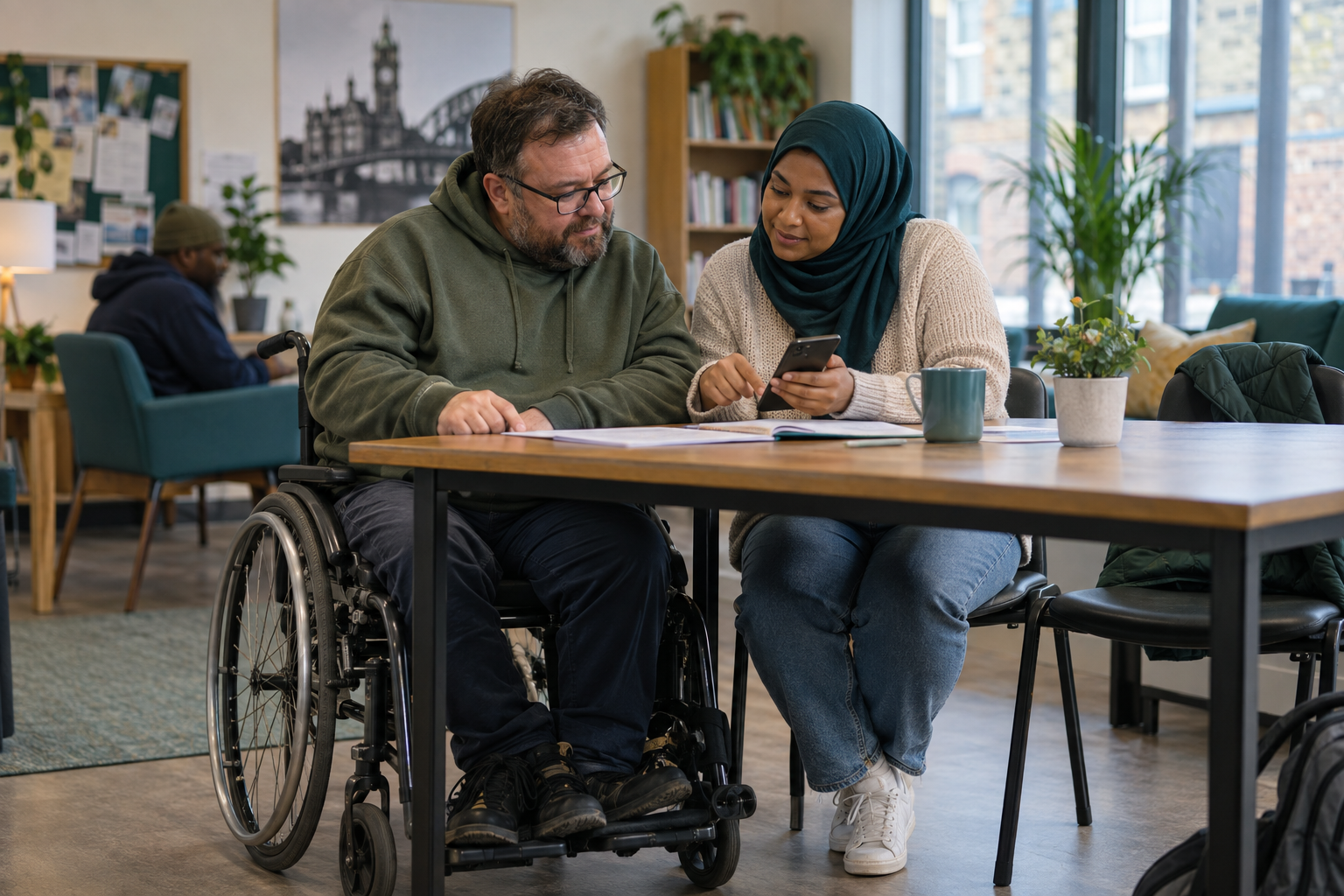
HOW A.D.D. SUPPORTS A PERSON FROM FIRST CONTACT TO THE NEXT STEP.
There is a difference between showing somebody a direction and walking some of the road with them. A signpost can point. A website can provide a link. An office can give a telephone number. A letter can say:
“Please contact the following organisation.”
All of these may be correct. And still the person may remain exactly where they were. Because sometimes the problem was never simply:
Where should I go? The problem was:
How do I get there from here?
That small difference lies at the centre of how A.D.D. wants to work.
We do not want merely to point.
We want, where reasonably possible, to walk with you.
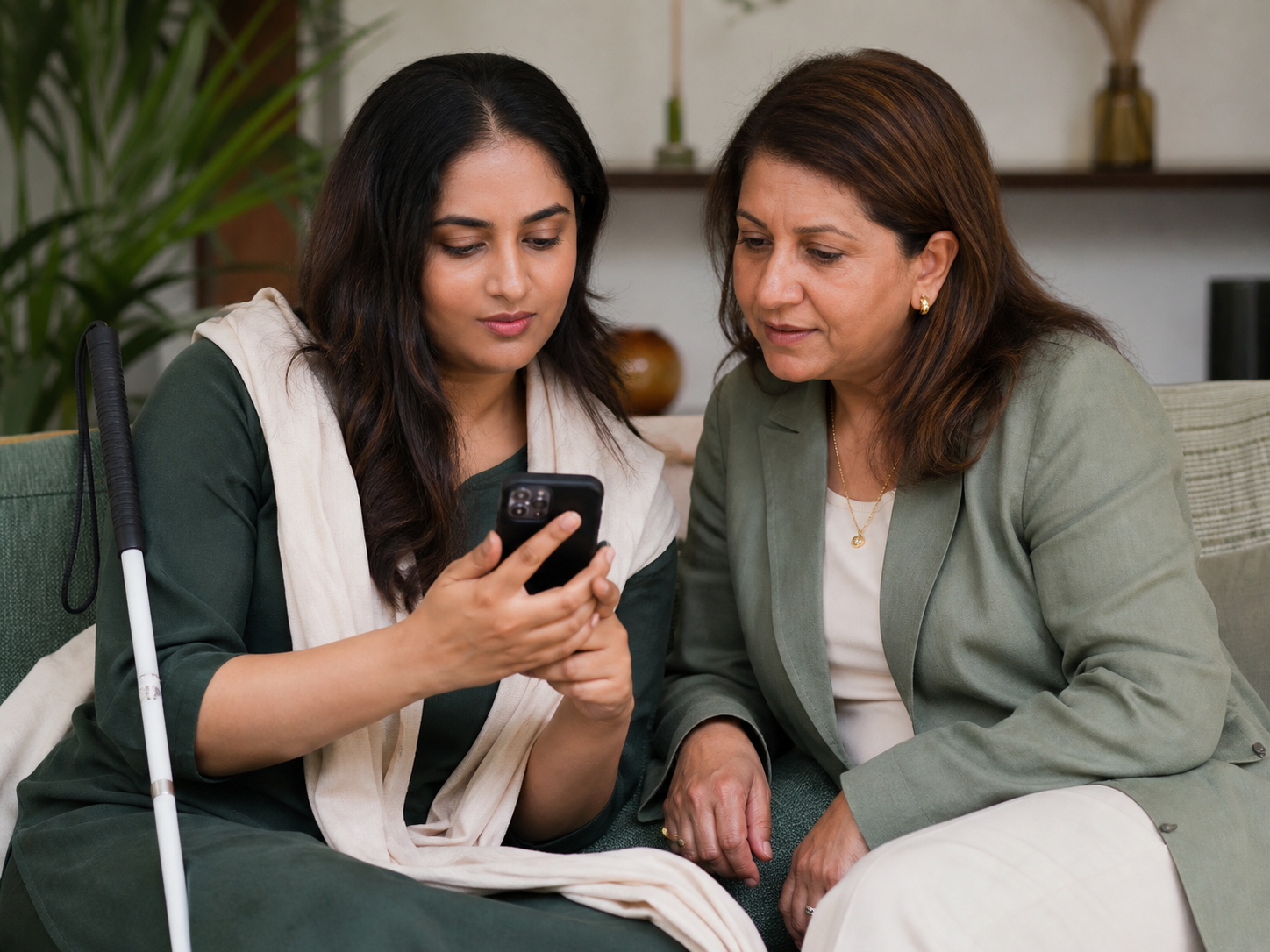
FIRST: TELL US WHAT IS HAPPENING.
You do not need to know the correct department before contacting A.D.D. You do not need to know whether your difficulty is called:
housing, benefits, disability, education, employment, isolation, digital exclusion, community difficulty, or something else. Those classifications may become important later.
But first:
Tell us what is happening to you.
In your own words. Your own order. Your own way. Some people tell their story chronologically. Some do not. Some arrive with a folder containing every document from the last five years. Some arrive with one letter folded in a pocket.
Some know precisely what they want. Others only know:
“Something is wrong, and I don't know what to do next.” That is still a beginning.

YOU DO NOT HAVE TO PRESENT YOUR PAIN PROFESSIONALLY.
This matters particularly to me. Systems often require people to translate suffering into administrative language. Dates. References. Evidence. Headings. Forms. Categories. Chronologies.
These things can be necessary. But pain itself does not happen alphabetically. A frightened person may repeat themselves. An exhausted person may forget an important date. Somebody living through several difficulties may begin with what appears to be the least important one.
A person may cry. Become angry. Fall silent. Laugh strangely while describing something that is not funny. None of this automatically means their underlying concern has no value.
A.D.D. hears the human story first.
Then, where necessary, help organise it into the language a system can understand.
The person should not have to become a lawyer, administrator, welfare adviser and professional writer merely to explain why they need somebody to listen.

WE LISTEN FOR THE PROBLEM AND THE PERSON BEHIND IT.
Suppose somebody says:
“I need help with Universal Credit.” That may indeed be the issue.
But perhaps they cannot use the online account. Perhaps they cannot understand the letter. Perhaps their disability makes concentration difficult. Perhaps English is not their strongest language. Perhaps they have received several contradictory messages. Perhaps they are frightened because their rent depends upon the outcome. Perhaps they have not slept properly for three nights.
If we respond only to the words “Universal Credit,” we may solve the wrong problem.
So A.D.D. asks:
What is making this difficult for you?
The answer helps determine what kind of support may actually be useful.

WE DO NOT TAKE YOUR LIFE OUT OF YOUR HANDS.
Helping can become dangerous when the helper begins enjoying control more than helping.
A.D.D. must guard against that.
The person remains the person. The life remains theirs. The decision remains theirs wherever the law and circumstances allow it. We may help explain. Organise. Draft. Telephone. Connect. Accompany. Ask questions. Find information. But wherever reasonably possible:
We work with you, not over you.
If a letter is being written in your name, you should know what it says. If somebody is being contacted about you, you should normally know why. If options exist, they should be explained. If you disagree with us, you remain entitled to disagree. Support does not transfer ownership of your life to the supporter.
Nothing About Me Without Me.
That is not merely a slogan for A.D.D.
It should become a working discipline.

WE FIND THE PART WE CAN ACTUALLY HELP WITH.
A complicated problem may contain several different problems. Some may fall within our practical capacity. Some may require professional advice.
Some may require an organisation with statutory powers. Some may need a solicitor. A doctor. A social worker. A safeguarding service. A specialist benefits adviser. A housing professional. A university procedure.
An emergency service. Or another organisation entirely. A.D.D. should never pretend competence merely because we want to be helpful.
False confidence can harm somebody. So we ask:
What can we responsibly do? What should somebody else do? And then the most important question:
How do we stop the person falling through the space between the two?

REFERRAL IS NOT GOODBYE.
This principle deserves to be unmistakable. The outcome should be recoreded not only the redirected or reffered department/organissation but also where the applicant went at first place.
If part of your matter belongs elsewhere, A.D.D. should not simply say:
“Here is the number. Good luck.”
Sometimes a referral is all that is necessary. But sometimes it is precisely where the person is mis-referred and becomes lost person. The organisation does not answer. The wrong department answers. The person cannot explain the matter. They are redirected again. A form arrives.
The form creates another question. An appointment is offered somewhere inaccessible. Or the person simply loses courage. So, where appropriate, possible, safe and with your consent, A.D.D. may help you reach the relevant service. We may help clarify what needs to be asked. Help organise information. Help prepare communication. And afterwards:
We can ask what happened?
Did you reach them? Were you understood? Did they respond? Is something still unresolved? Do we need to reconsider the route? A.D.D. cannot control another organization.
We cannot guarantee its response. But:
Putting you through should not mean putting you away.
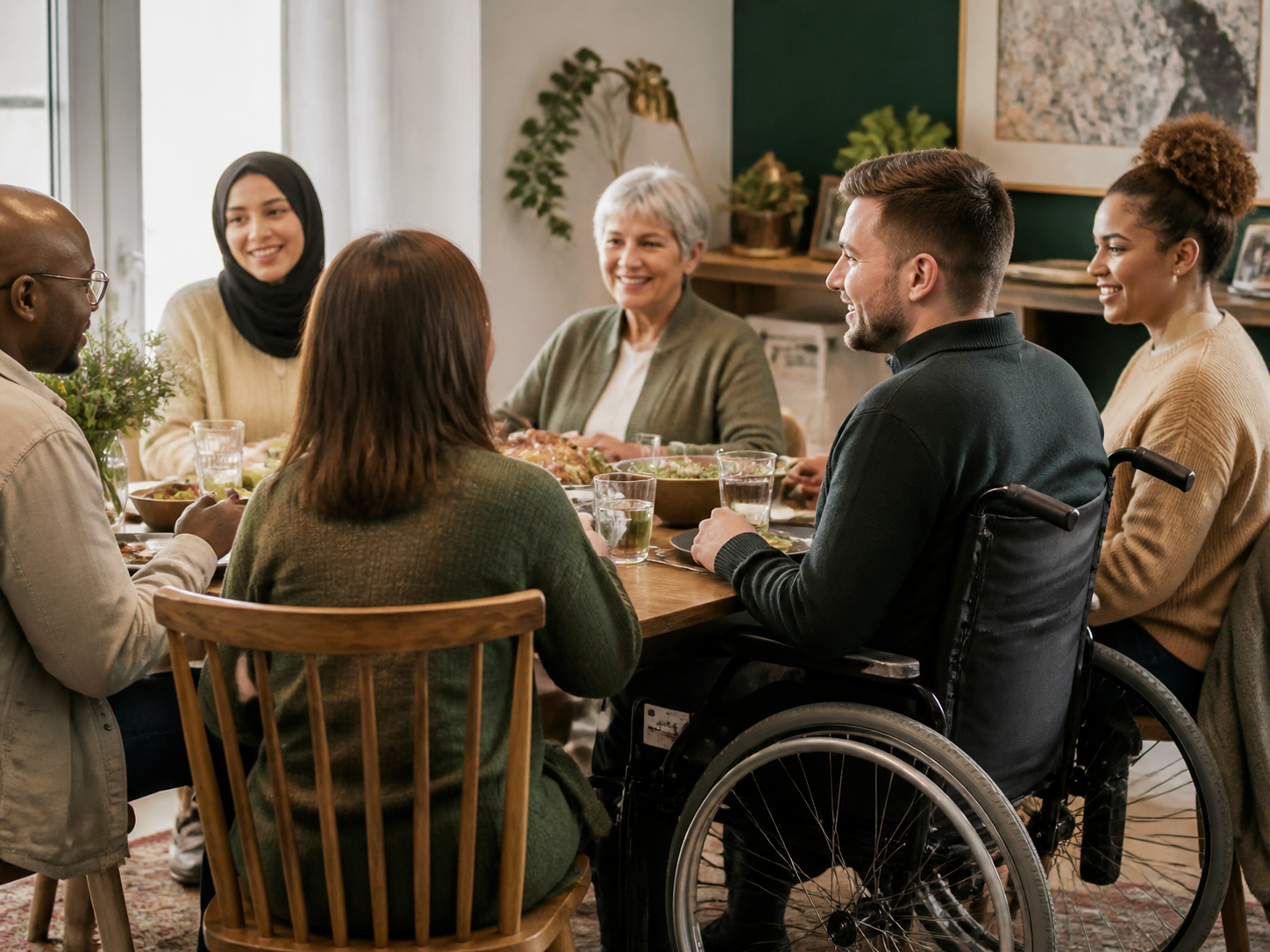
WE WALK WITH SUCCESS.
Sometimes the answer will be yes. The application succeeds. The adjustment is made. The misunderstanding is corrected. The money arrives. The service responds. The appointment happens. The person finds appropriate specialist support. The problem that occupied the whole room finally becomes small enough to put in a drawer.
Wonderful. Celebrate it. Not because A.D.D. needs to claim somebody else's victory. But because relief deserves recognition too. Perhaps we have become so accustomed to recording problems that we sometimes forget to record the moment the problem ends.
Let relief have its moment.
Smile. Make tea. Play something. Telephone the person who worried with you. And remember:
Life is still beautiful.

AND WE WALK WITH DISAPPOINTMENT.
Not every application succeeds. Not every complaint is upheld. Not every institution accepts our understanding of events. Not every illness improves. Not every relationship repairs itself. Not every injustice receives the remedy we hoped for. Humanity cannot promise outcomes it does not control.
But failure should not automatically mean abandonment. Sometimes after an unsuccessful result, the first useful thing is simply to sit with the person and understand:
What happened? Is there another legitimate route? Is professional advice now needed? Can anything be learned? Does the person want to continue? Or has the time come to stop fighting this particular battle and protect what remains of their energy?
Walking with somebody does not mean forcing them to keep walking.
Sometimes humanity says: Continue.
Sometimes it says: Rest.
And sometimes: This road has ended. Let us see whether another exists.
THE HEART GETS TIRED TOO.
We understand physical fatigue. The legs tire. The back aches. The eyes become heavy. The body asks for rest. But there is another fatigue that is harder to measure.
The heart gets tired too.
Not merely the heart of anatomy, but that ancient human idea of the heart as the home of feeling:
where affection lives, where disappointment accumulates, Where expectations breed, where hope rises, where rejection lands, where grief sits, where courage repeatedly has to be rebuilt. Where consideration bases.
A person may still be walking while something inside them has sat down. That fatigue deserves consideration. Every tired heart does not always need professional treatment. Sometimes it needs silence. Music.
A poem. A garden. A conversation. A cup of tea with somebody who does not keep looking at the clock. A flute heard from another room. A painting. A remembered song. Something beautiful that asks nothing in return.
Sometimes the soul does not need another form.
It needs somewhere to breathe. This is why creativity belongs within A.D.D., not outside it. We will return to this more fully on our Arts, Music & Creativity page.
HELPING COSTS SOMETHING.
Whoever never lessens his own Does good to none, leaves them alone. True kindness asks a price to pay, Always self-first hearts give none away.
(Rizvi)
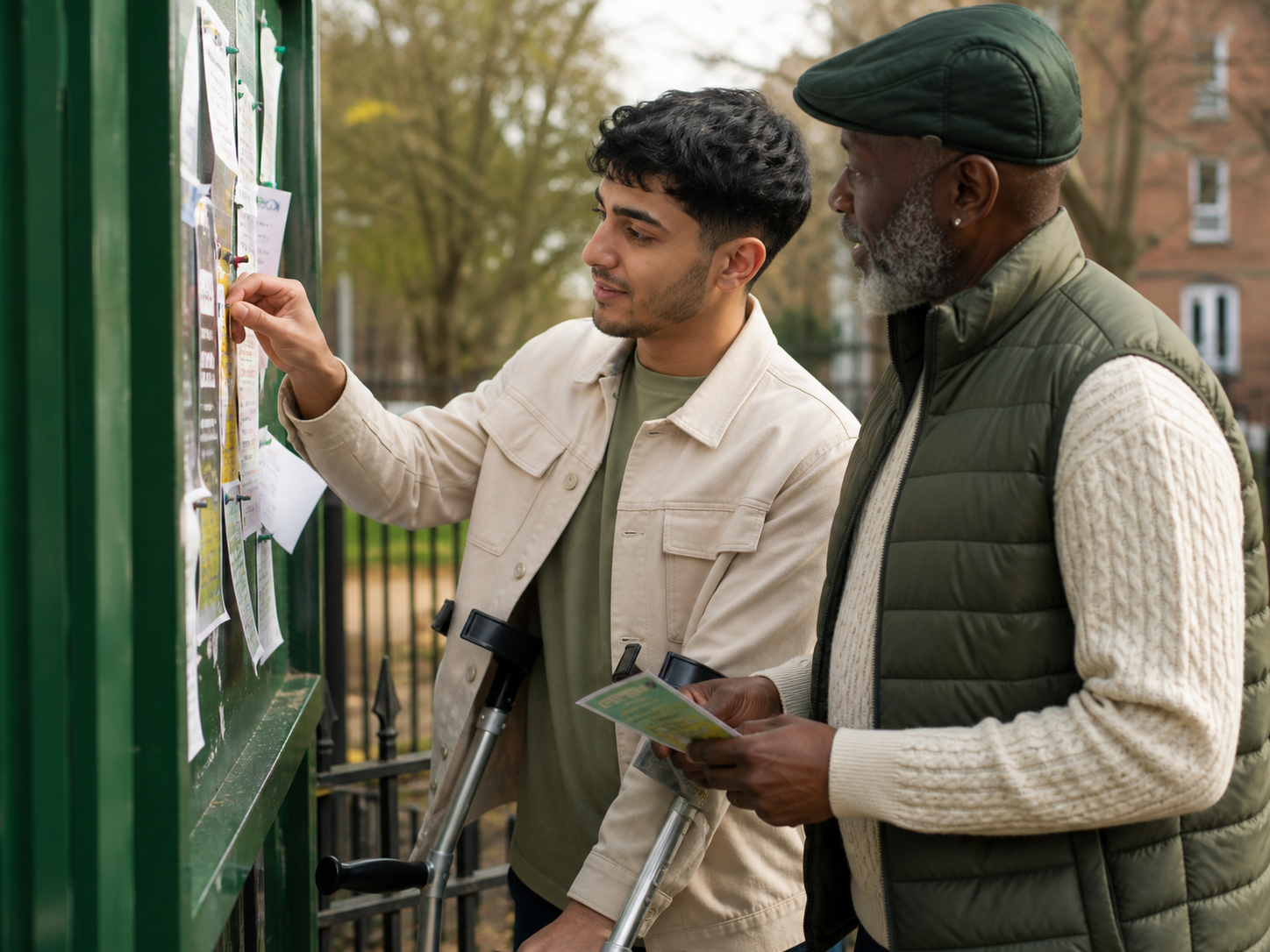
There is another truth we should admit. Helping is not always convenient. If both of my hands are completely occupied holding my own possessions, I cannot hold yours. Sometimes:
We have to put something down before we can hold another hand.
Perhaps ten minutes of our time. Perhaps convenience. Perhaps an unnecessary purchase. Perhaps an evening. Perhaps the comfort of saying: “Not my problem.” This does not mean destroying ourselves.
It does not mean neglecting our health, families, responsibilities or reasonable boundaries. Self-sacrifice without wisdom can create another person needing rescue. But humanity has always involved some willingness to make room.
To care for another person, we occasionally have to move ourselves slightly away from the center of our own universe.
Not disappearing from it. Just make room for another.
DO NOT LET INGRATITUDE TEACH YOU CRUELTY.
This lesson is difficult. Sometimes we help somebody sincerely. Give time. Trust. Knowledge. Opportunity. Perhaps even sacrifice. And later:
Nothing. No gratitude. No acknowledgement. Sometimes worse. The hand we held may one day withdraw. The person we helped may forget. They may disappoint us.
They may even hurt us. What then? Learn. Establish boundaries. Do not repeatedly offer yourself for exploitation. Wisdom is not foolishness.
But be careful about one thing:
Do not allow one person's ingratitude to punish the next person who has done nothing to you.
Otherwise the wound travels. Somebody hurts us. We close. An innocent person later approaches.
We refuse them because of somebody else's behavior.
And without intending it, the original hurt has reproduced itself through us.
That gives thanklessness too much power.
Let experience make your kindness wiser, not smaller.
Protect the heart. But do not turn it to stone merely because somebody once failed to appreciate its warmth.
APPRECIATION MATTERS.
A.D.D. nevertheless believes gratitude matters enormously. Kindness should not be treated as an unlimited natural resource that somebody else is obliged to provide. Notice the person who helped. Remember them. Say thank you. Ask how they are. Perhaps one day help them. Not as repayment. Not because humanity keeps accounts. But because the person who held you is also human. They get tired too.
Even the hand that helps needs occasionally to be held.
This is how A.D.D. wants to escape the old division between giver and receiver. Today I have strength here. You have difficulty. Tomorrow:
The chairs may change.
ONE HEART CAN BECOME VERY LARGE.
The physical heart has dimensions. The human heart of feeling appears to have something stranger. The more sincerely it learns to recognize other lives, the more room it seems capable of making. One person can grieve for people they have never met. A poet can carry the sorrow of generations. A musician can express pain springing from migration. A volunteer can remember the faces of people whose lives briefly crossed theirs. A parent can feel a child's wound inside their own body. Perhaps this is one of the mysteries of being human:
One truly sincere heart can accommodate the pain, sorrows and traumas of millions of hearts.
Not solve them all. No heart can do that. Not carry them without rest. That would break it. But recognise them. Make room for them. Refuse to declare them irrelevant merely because they belong to somebody else. That is enough to change how we live.
WE DO NOT PROMISE TO WALK FOREVER.
Walking with somebody must have purpose. The goal is not permanent dependence upon A.D.D. Where possible, support should lead towards greater confidence. Greater understanding. Greater connection. Greater independence. Perhaps today we help make the call. Next time you make it while we sit beside you. After that, perhaps you make it yourself.
And one day, perhaps you help somebody else make theirs. Then the circle changes. The person who arrived asking:
“Can somebody help me?”
may eventually become the person saying:
“I know how this feels. Sit here. Let us do it together.”
That is not simply a completed case. That is regenerated courage.
AND IF YOU COME BACK?
Come back. Needing help again does not mean the first help failed. Human beings do not graduate permanently from vulnerability. A person can become independent in one matter and need support in another. We become ill. We age. Circumstances change. Technology changes. Families change. Work changes. Confidence changes. Life occasionally rearranges the furniture without asking us. There should be no humiliation in returning. A.D.D.'s purpose is not to create a test in which needing help twice counts as failure.
Independence does not mean never needing another human being.
It means retaining as much agency, dignity and ability as reasonably possible while recognizing an ancient truth:
None of us was designed to do everything alone.
FROM FIRST CONTACT TO THE NEXT STEP.
So this is how A.D.D. hopes to walk:
We listen. We respectfully and sincerely try to understand. We identify what is actually making the situation difficult. We recognise what you can already do. We determine what part we may responsibly help with. We identify specialist or external help where necessary. We help make the connection where appropriate. We do not regard referral automatically as goodbye. We follow up where reasonably possible. We remain honest about what we cannot do. We respect your choices and boundaries. We protect ours too. We learn from success. We do not abandon dignity in failure. And throughout:
You remain the central person in your own story.NOT A CASE. A PERSON.
Eventually every organisation needs administration. Names. Dates. Records. References. Files. A.D.D. will too. But we should remember what administration can easily forget. Behind the reference number is a face. Behind the form is a morning somebody struggled to get through. Behind the complaint is a reason somebody finally decided:
Enough. Behind the application is a hope. Behind the missed appointment may be a journey nobody asked about. Behind the angry email may be three sleepless nights. Behind the silence may be somebody waiting to discover whether anyone noticed.